


PROLOGUE
At its core, Neelam Gaur’s practice emerges from an ontological inquiry into the nature of transformation. Her work positions the human subject not as a fixed entity but as a fluid being in perpetual negotiation with memory, myth, and materiality. This exhibition catalogues an artistic trajectory that does not separate the personal from the philosophical; instead, it recognizes lived experience as a legitimate site of theoretical knowledge.
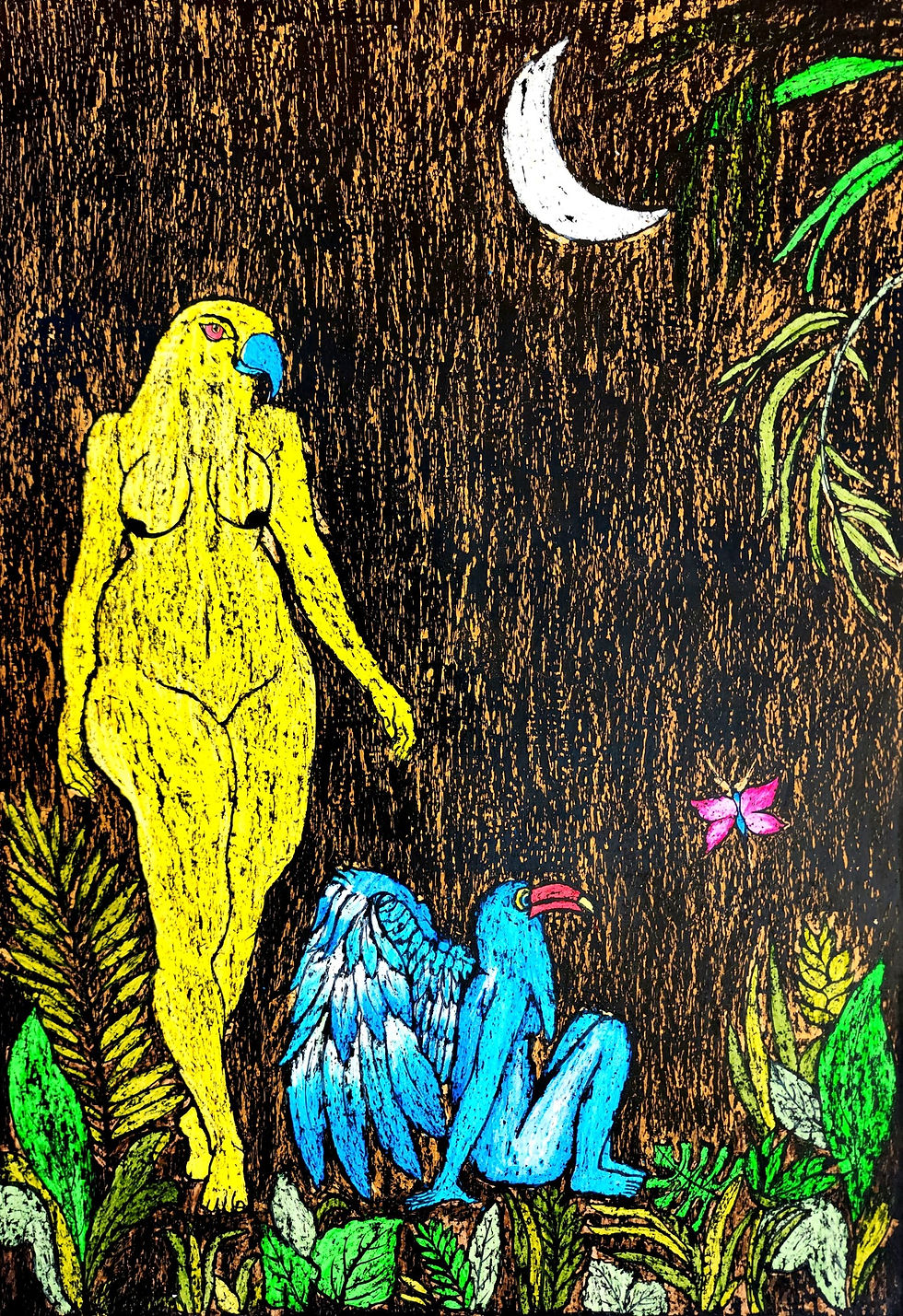
Following a life-altering event in 2019, Gaur’s engagement with art shifted from expression to reconstruction. The studio became a phenomenological space in which she examined the body not merely as biological matter but as a vessel of metaphor, history, and narrative. The resulting imagery — hybrid beings drawing from Hindu mythic archetypes such as Garuda, Hanuman, Narsimha, and Navgunjar — operates as a visual discourse on liminality. These figures are neither entirely human nor entirely other; they inhabit what theorists such as Bhabha describe as the “in-between,” an interstitial zone where identity is continually re-articulated.
The series Featured Fables and Phantom Time extend this inquiry by destabilising conventional temporal structures. Here, time is not linear but layered — echoing the philosophical understanding that memory is not an archive but a dynamic field where past and present co-produce meaning. Gaur’s textured surfaces enact this complexity: each layer both conceals and reveals, embodying the tension between erasure and emergence. In this sense, her paintings function as palimpsests, inviting viewers to consider how trauma, imagination, and myth coalesce to form new epistemologies of the self.
Rather than employing mythology as mere iconography, Gaur approaches it as a conceptual framework — a way to question how cultures encode resilience, protection, and transcendence into symbolic forms. Her hybrid guardians can thus be read as philosophical constructs: metaphors for the multiplicity within each individual, and embodiments of the potential for self-reinvention.
This catalogue presents a body of work deeply rooted in the belief that imagination is not escapist but ontological — a mode of becoming. Through her practice, Gaur positions art as a site where the fractured self can be reassembled, not by returning to a former coherence, but by accepting complexity as its own form of wholeness.



Loading days...
1 hr
1,000 Indian rupees
Loading days...
1 hr
1,000 Indian rupees
Loading days...
1 hr
2,000 Indian rupees
Loading days...
1 hr
3,000 Indian rupees
Loading days...
1 hr
1,499 Indian rupees
1 hr
499 Indian rupees
1 hr
1,499 Indian rupees